Walking Pad Weight Limit Guide (2026)
Current product-safety notice: CPSC warned consumers on April 16, 2026 to stop using specified Sperax Pro, Q1, RM-01 and RM-02 walking pads and treadmills. We removed older recommendations and shopping links for that brand while exact models are re-audited. Check the official CPSC warning and follow its stop-use instructions.
By Matt Sullivan · Last updated March 9, 2026
Walking pads have become the default under-desk exercise solution for remote workers, but there is one specification most buyers overlook until it is too late: the weight limit. Every walking pad has a maximum user weight capacity, and exceeding it does not just void your warranty — it compromises the motor, the belt, and your safety.
This guide compares the weight limits of 8 popular walking pads, explains how those limits are set, and helps you find the right walking pad for your actual body weight — with an honest safety margin built in.
Safety note: Always follow the manufacturer's stated weight capacity. Using a walking pad above its rated limit increases the risk of motor failure, belt slippage, and structural damage. If you have mobility concerns or medical conditions, consult a healthcare provider before starting any walking program.
Why Walking Pad Weight Limits Matter
A walking pad weight limit is not a suggestion — it is an engineering constraint. Here is what it affects:
Motor longevity. Walking pad motors are rated for a specific load. A 2.0 HP motor designed for a 220 lb user will run at higher temperatures and wear faster under a 260 lb user. Over months, this shortens the motor's lifespan significantly.
Belt stability. The walking belt is tensioned for a specific weight range. Heavier users create more friction between the belt and the deck, which can cause slipping, uneven wear, and in some cases, the belt shifting to one side during use.
Frame integrity. Budget walking pads use lightweight aluminum frames designed to flex under a specific load. Exceeding the weight limit stresses joints and welds, increasing the risk of structural failure — particularly at the folding hinge on foldable models.
Warranty validity. Nearly every walking pad warranty excludes damage caused by exceeding the stated weight limit. If your motor burns out at month 4 because you were 40 lbs over the rated capacity, the claim will be denied.
Walking Pad Weight Capacity Comparison Table
| Walking Pad | Weight Limit | Motor | Speed Range | Belt Size | Foldable | Price | Buy |
|---|---|---|---|---|---|---|---|
| WalkingPad R2 | 242 lbs (110 kg) | 1.25 HP | 0.5–6.2 mph | 17.3" × 47.2" | ✅ Yes | ~$450 | Check on Amazon |
| WalkingPad X21 | 242 lbs (110 kg) | 1.0 HP | 0.5–7.5 mph | 18.5" × 47.6" | ✅ Yes | ~$500 | Check on Amazon |
| Goplus 2-in-1 | 265 lbs (120 kg) | 2.25 HP | 0.6–7.5 mph | 16.5" × 44" | ❌ No | ~$250 | Check on Amazon |
| UREVO 2-in-1 | 265 lbs (120 kg) | 2.5 HP | 0.6–7.5 mph | 16.5" × 46" | ❌ No | ~$280 | Check on Amazon |
| REDLIRO Under Desk | 220 lbs (100 kg) | 2.0 HP | 0.5–6.0 mph | 16" × 42" | ❌ No | ~$200 | Check on Amazon |
| UMAY Under Desk | 275 lbs (125 kg) | 2.5 HP | 0.6–6.0 mph | 17" × 44" | ✅ Yes | ~$320 | Check on Amazon |
| XTERRA Fitness TR150 | 250 lbs (113 kg) | 2.25 HP | 0.5–10 mph | 16" × 50" | ✅ Yes | ~$350 | Check on Amazon |
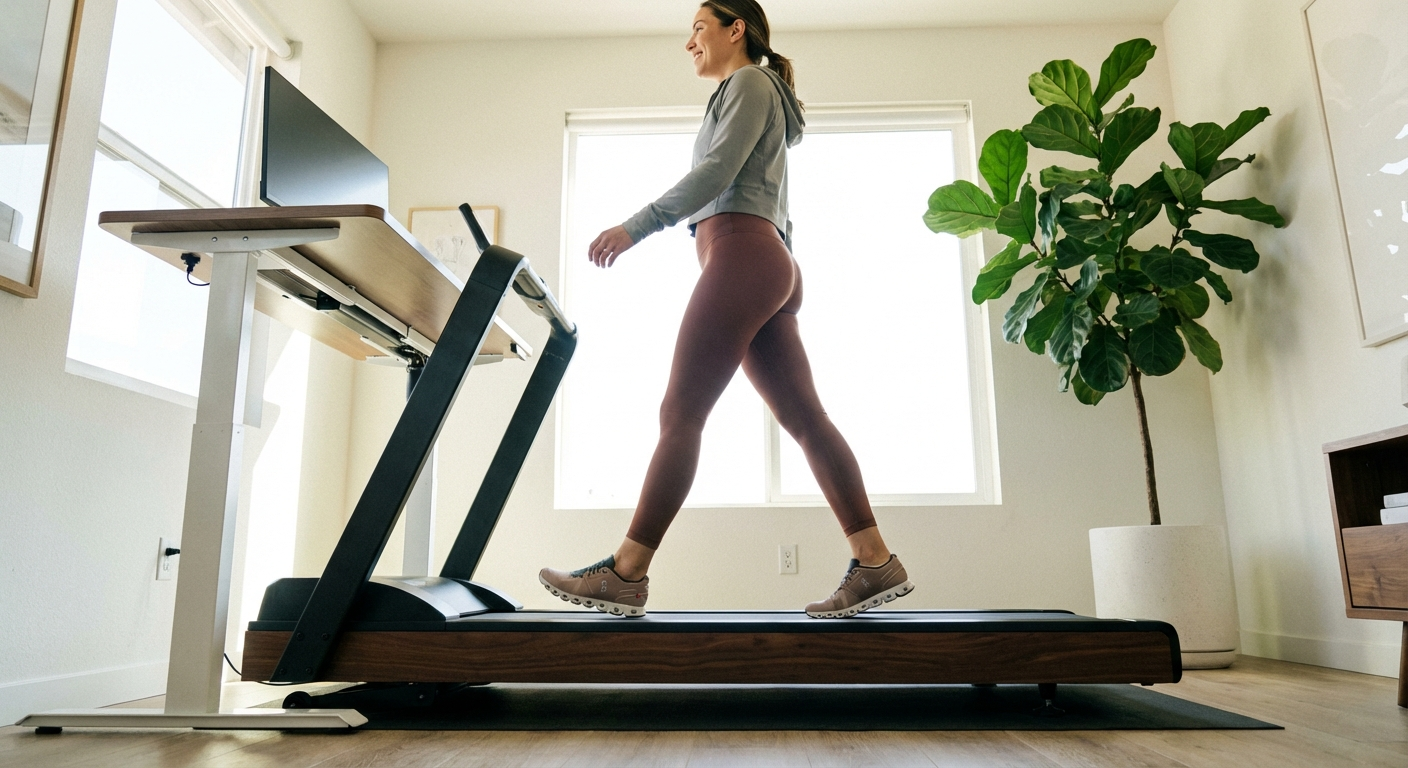 Choosing a walking pad with an appropriate weight limit is crucial for safety and durability.
Detailed Breakdown by Weight Range
Under 220 lbs (100 kg) — Most Options Available
If you weigh under 220 lbs, every walking pad on this list is within your range with a comfortable safety margin. Your decision can focus entirely on features, size, noise level, and price rather than weight capacity.
Recommended picks:
- Best value: REDLIRO Under Desk (~$200) — the lowest price point with adequate motor power
- Best quality: WalkingPad R2 (~$450) — premium build, whisper-quiet operation, compact fold
- Best speed range: XTERRA TR150 (~$350) — goes up to 10 mph if you want to jog occasionally
At this weight range, the 20% safety margin rule (explained below) is met by all models. Choose based on your desk height, available space, and whether you need foldability.
220–265 lbs (100–120 kg) — Check Carefully
This is where weight limits start to filter out options. The REDLIRO drops out at its 220 lb cap, and several others sit right at the boundary.
Key considerations at this weight:
- Avoid the REDLIRO entirely — even at exactly 220 lbs, you have zero safety margin
- The WalkingPad R2 and X21 (242 lb limit) work for users up to approximately 220 lbs with adequate margin
Recommended picks:
- Best under 240 lbs: UREVO 2-in-1 — strong motor (2.5 HP) and 265 lb limit
265–300 lbs (120–136 kg) — Limited Options
The honest assessment: If you weigh between 265 and 300 lbs, the walking pad market does not serve you well. The highest-capacity models on this list max out at 275 lbs. You have two realistic options:
- Choose the UMAY Under Desk (275 lb limit) — this gives usable margin up to about 250 lbs but is not recommended for users above 260 lbs
- Consider a light commercial treadmill instead — models from NordicTrack, Sole, and Horizon offer 300–350 lb capacities with commercial-grade motors and frames, though they are larger and more expensive
Over 300 lbs (136+ kg) — Walking Pads Are Not Recommended
No consumer walking pad on the market is rated for users over 300 lbs. This is not a product limitation you can work around — the motors, frames, and belts are physically not designed for this load.
Alternatives for users over 300 lbs:
- Sole F63 or F80 — rated to 325 lbs with a full-size frame and commercial motor
- NordicTrack Commercial series — rated to 300 lbs with robust build quality
- Horizon T101 — rated to 300 lbs at a moderate price point
These are full treadmills, not walking pads. They require more space and will not fit under a standing desk. But they are engineered for the load and will last.
How Weight Limits Are Determined
Walking pad weight limits are set by the manufacturer based on three factors:
Motor Rating
The motor's continuous horsepower determines how much load it can sustain without overheating. A 1.0 HP motor running at 70% capacity under a 200 lb user will run at 95%+ under a 260 lb user — dramatically shortening its lifespan and increasing heat generation.
Frame and Deck Testing
Manufacturers test the frame and walking deck under static and dynamic load. Dynamic load testing simulates the impact forces of walking, which are approximately 1.2–1.3x body weight per step. A 250 lb user generates roughly 300–325 lbs of impact force per stride.
Belt Friction Coefficient
Heavier users create more friction between the belt and the deck surface. Higher friction means more heat, faster belt wear, and greater strain on the motor. Walking pad belts are thinner than treadmill belts and less tolerant of excess friction.
Important: Manufacturer weight limits already include some engineering margin, but the amount varies. Premium brands (WalkingPad, XTERRA) tend to be more conservative with their ratings. Budget brands sometimes rate closer to the actual failure threshold. This is why the 20% rule matters.
Safety Considerations
The 20% Safety Margin Rule
A widely recommended practice in fitness equipment selection is to choose a machine rated at least 20% above your body weight. This accounts for:
- Dynamic impact forces during walking (1.2–1.3x body weight)
- Motor degradation over time
- Temperature variations (motors perform worse in warm rooms)
- Day-to-day weight fluctuations
Example: If you weigh 200 lbs, look for a walking pad rated to at least 240 lbs. If you weigh 230 lbs, target a 275+ lb capacity.
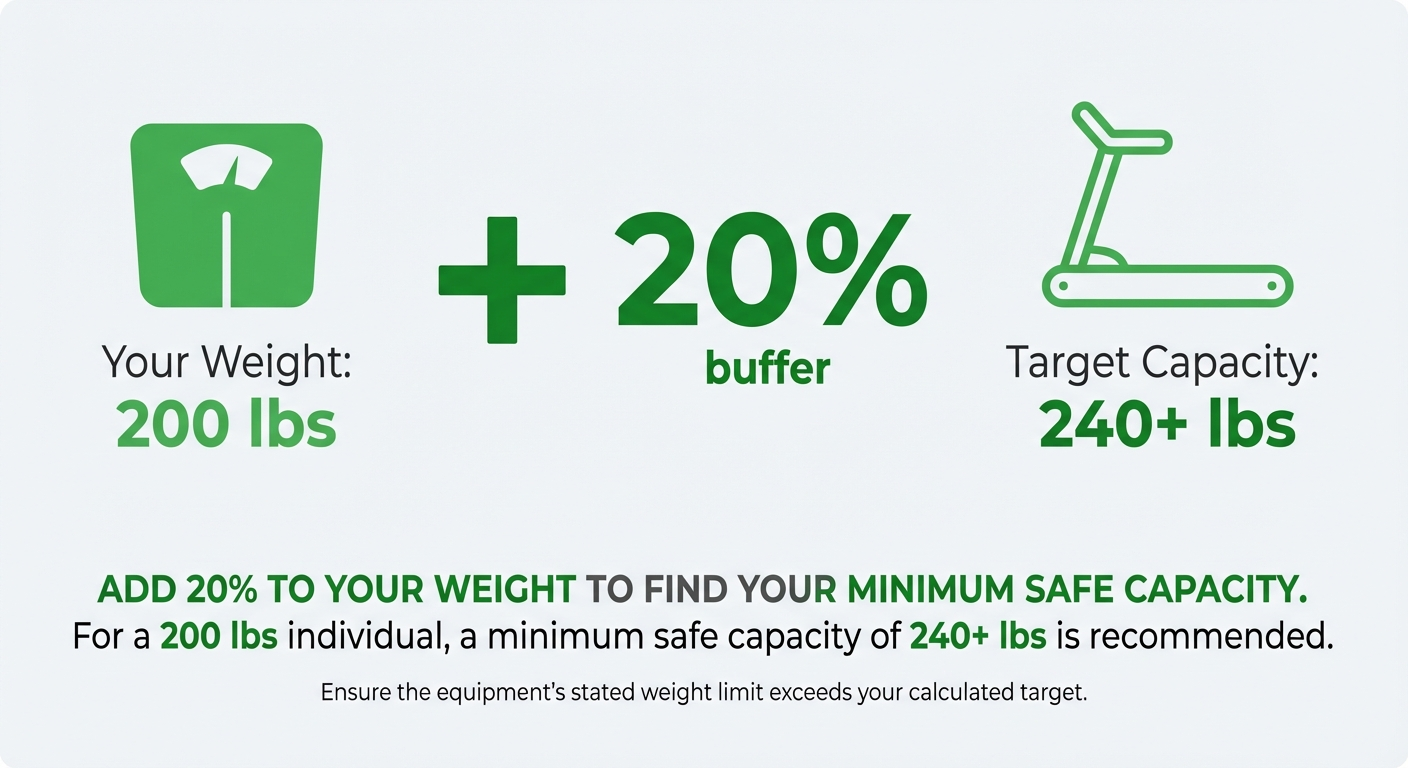 Following the 20% safety margin rule ensures your walking pad operates safely and lasts longer.
Belt Slippage Warning Signs
If you are near a walking pad's weight limit, watch for these early warning signs:
- Belt hesitates or stutters when you step on
- Belt shifts to one side during use
- Motor makes a whining noise under load that was not present initially
- Belt feels slower than the displayed speed
- Burning smell from the motor or belt area
If you notice any of these: Stop using the walking pad immediately. These are signs the machine is operating beyond its safe capacity. Continued use risks motor failure or belt breakage.
Placement and Surface
Walking pads must be placed on a flat, stable surface. Carpet increases motor strain because the walking pad cannot dissipate heat through its underside as effectively. Hard floors (wood, tile, concrete) are ideal. If you must use carpet, place the walking pad on a hard mat and choose a model with at least 20% weight margin above your body weight.
What Happens If You Exceed the Weight Limit
This is not theoretical — here is what actually fails:
Motor overheating (most common). The motor runs at or above its thermal limit, triggering automatic shutoff on better models or sustained overheating on cheaper ones. Over weeks, this degrades the motor windings permanently. The walking pad starts running slower, louder, and eventually fails to start.
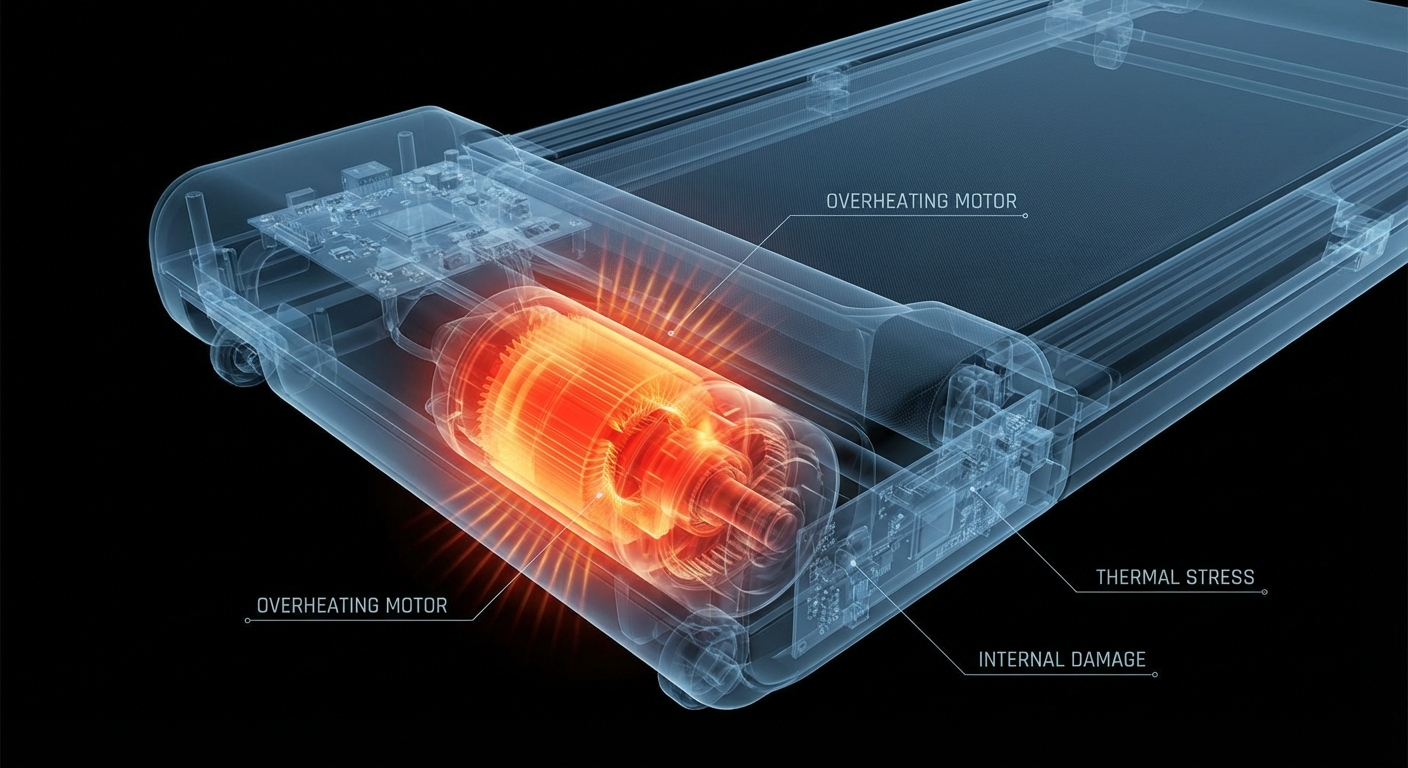 Exceeding the weight limit is the fastest way to cause permanent damage to the motor.
Belt slippage. Excess friction causes the belt to slip on the rollers, creating a jerky walking experience and potentially causing you to stumble. The belt also wears unevenly, creating thin spots that can tear during use.
Frame warping. On foldable walking pads, the folding hinge is the weakest structural point. Excess weight can cause the hinge to bend or fail, particularly during the transition from standing still to walking when impact forces spike.
Deck cracking. The walking deck absorbs impact with each step. Exceeding the weight limit concentrates stress beyond the deck's design tolerance, particularly at the front (where heel strike occurs) and at the folding point.
How to Choose Based on Your Weight
Decision Framework
Step 1: Determine your current weight at the heaviest you typically are (e.g., after a meal, in shoes and work clothes — the conditions you will actually walk in).
Step 2: Add 20% for the safety margin. This is your minimum weight capacity target.
Step 3: Filter the comparison table above to models that meet or exceed your target.
Step 4: Among qualifying models, choose based on: speed range, belt width, noise level, foldability, and price.
| Your Weight | Minimum Capacity Target (20% margin) | Recommended Models |
|---|---|---|
| Under 180 lbs | 216 lbs | Any model on this list |
| 220–230 lbs | 276 lbs | UMAY (borderline), or consider full treadmill |
| 230+ lbs | 276+ lbs | Full treadmill recommended (Sole, NordicTrack, Horizon) |
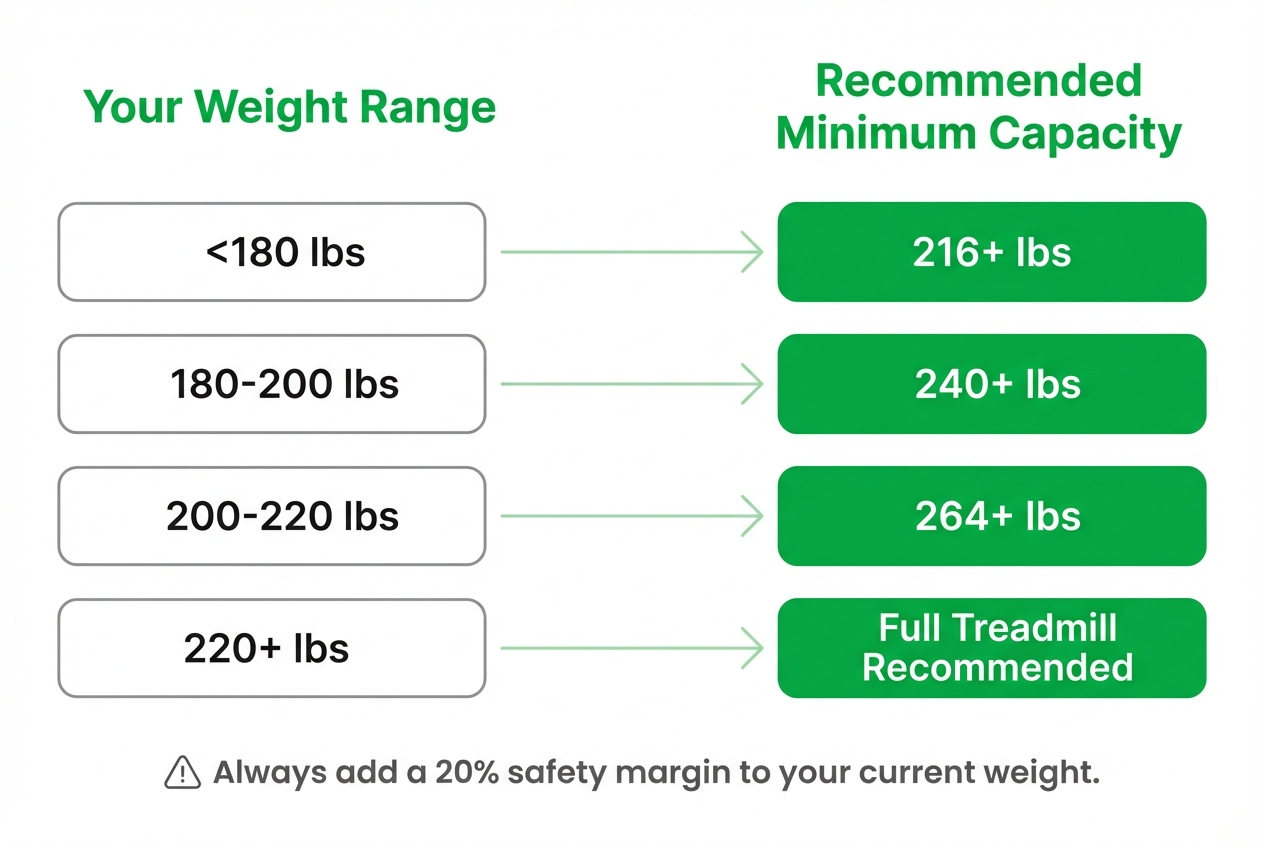 Use this flowchart to find the right walking pad capacity for your body weight.
Walking Pad vs Treadmill for Heavy Users
If the comparison table above does not include a model with enough capacity for you, a full treadmill is not a downgrade — it is the right tool for your body. Here is how they compare:
| Feature | Walking Pad | Full Treadmill |
|---|---|---|
| Max weight capacity | 220–275 lbs | 300–400 lbs |
| Motor | 1.0–2.5 HP | 2.5–4.0 HP |
| Belt width | 16–18.5" | 20–22" |
| Belt length | 42–50" | 55–60" |
| Speed range | 0.5–7.5 mph | 0–12+ mph |
| Fits under desk | ✅ Yes | ❌ Usually not |
| Foldable | Some models | Some models (but large folded) |
| Price | $200–$500 | $400–$2,000+ |
The tradeoff is space and portability. Walking pads win on compactness. Full treadmills win on capacity, durability, and safety for heavier users. For more comparisons, see our walking pad vs treadmill guide.
Walking Pad Pros and Cons
Walking Pad Pros:
- Compact footprint — fits under most standing desks
- Foldable options for small spaces
- Quieter than full treadmills at walking speeds
- Lower price point ($200–$500 range)
- Easy to use without handrails for slow walking
Walking Pad Cons:
- Weight capacity tops out at 275 lbs — not suitable for heavier users
- Motors are not rated for sustained running speeds
- No incline options on most models
- Thinner belts wear faster under heavy use
- Consumer-grade durability vs. commercial treadmills
Frequently Asked Questions
What is the highest weight limit for a walking pad?
Most consumer walking pads cap out between 265 and 275 lbs (120–125 kg). The UMAY Under Desk model at 275 lbs is among the highest available. No widely available walking pad exceeds 300 lbs. Users above 275 lbs should consider a light commercial treadmill instead.
Can I use a walking pad if I am close to the weight limit?
Technically yes, but it is not recommended. Being within 10% of the weight limit means you have virtually no safety margin for dynamic impact forces, which are 1.2–1.3x your body weight while walking. This accelerates motor and belt wear and increases the risk of failure. Aim for at least a 20% buffer.
Does walking speed affect the weight limit?
The stated weight limit applies at all speeds, but higher speeds increase impact forces. Walking at 2 mph generates less per-step impact than walking at 5 mph. If you are near the weight limit, sticking to lower speeds (under 3 mph) reduces stress on the motor and belt — but it does not change the fundamental capacity constraint.
How do I know if my walking pad is struggling with my weight?
Watch for: motor whining or grinding noises that worsen over time, belt hesitation when you step on, belt drifting to one side, the walking pad running slower than the displayed speed, or any burning smell. These are signs the machine is operating at or beyond its capacity.
Do shoes affect the walking pad weight limit?
Shoes add 1–3 lbs which is negligible for weight capacity purposes. However, shoe type affects belt wear — running shoes with aggressive tread patterns wear the belt faster than flat-soled walking shoes. Smooth-soled sneakers are ideal for walking pad use.
Is the weight limit the same for walking and running?
Yes, the stated weight limit is a static figure. However, running generates 2–3x body weight in impact force per stride, compared to 1.2–1.3x for walking. A walking pad rated for 250 lbs handles a 250 lb walker but is structurally stressed by a 250 lb runner. Most walking pads are not designed for running regardless of the user's weight.
Should I buy a walking pad or a treadmill if I weigh over 250 lbs?
A full treadmill is the safer choice. Walking pads in the 265–275 lb capacity range give a 250 lb user only a 6–10% margin — below the recommended 20%. A mid-range treadmill rated to 300–325 lbs provides a proper safety buffer and a more durable motor, belt, and frame. See our walking pad vs treadmill comparison for detailed analysis.
Sources and Methodology
This guide compares manufacturer-stated weight capacities for 8 popular walking pads available in 2026. Weight limits, motor specs, and belt dimensions are sourced from official product listings and manufacturer documentation.
References:
- OSHA: Walking-Working Surfaces — osha.gov/walking-working-surfaces
- American College of Sports Medicine: Guidelines for Exercise Testing and Prescription
- Consumer Product Safety Commission: Exercise Equipment Safety — cpsc.gov
The 20% safety margin recommendation is based on fitness equipment industry best practices and accounts for dynamic impact forces during walking (approximately 1.2–1.3x body weight per stride as documented in biomechanical research).
Prices are approximate and reflect typical retail pricing at time of publication. We link to Amazon search results to ensure links remain functional. We may earn a commission on purchases at no additional cost to you. Affiliate relationships do not influence recommendations.
Visual Guide Gallery